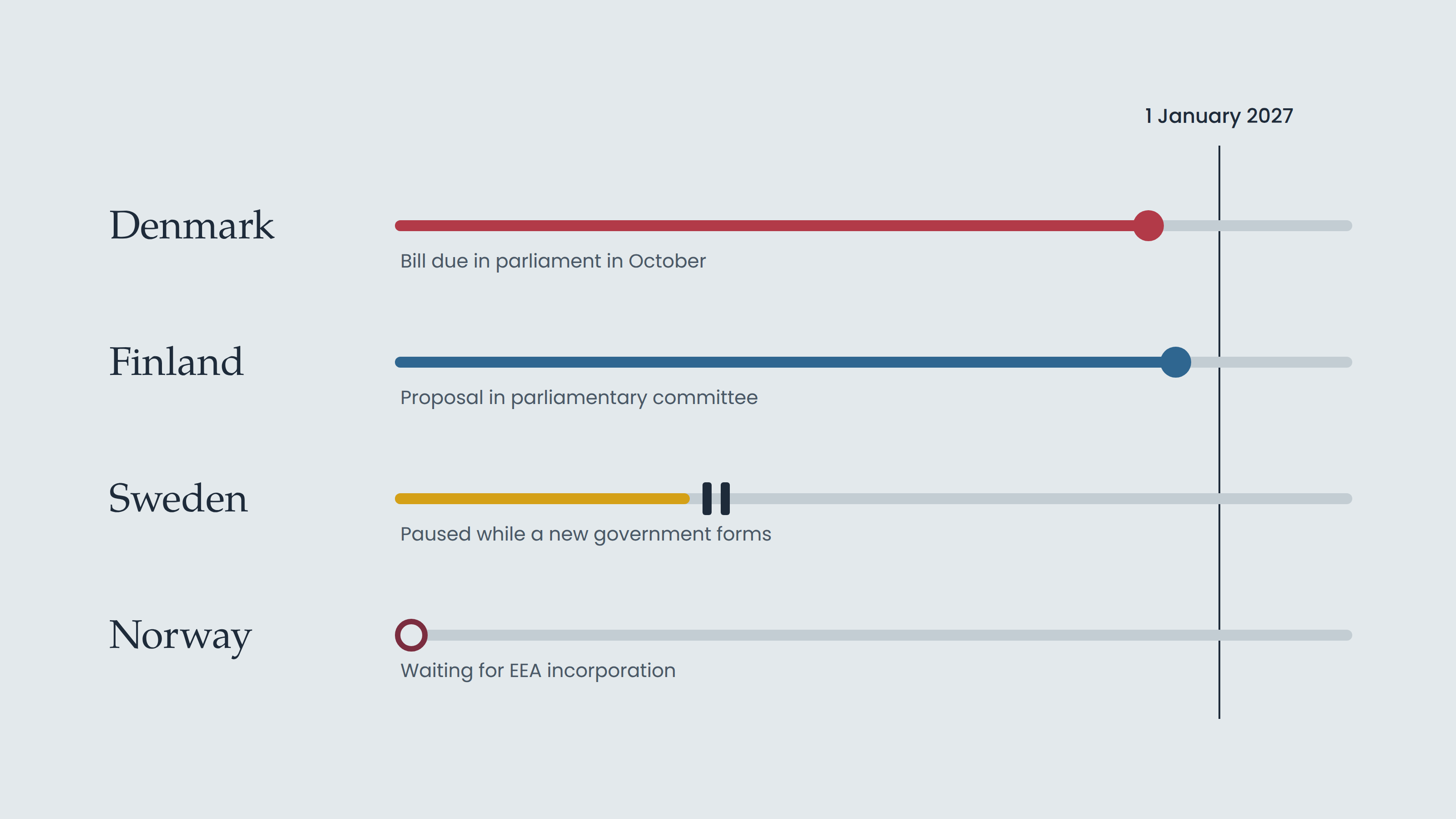
Six months ago it was easy to describe how the Nordics were handling the EU Pay Transparency Directive. Denmark and Finland were drafting, Sweden had stepped back, and Norway wasn't yet on the clock. Since then, Denmark has changed government and Sweden has voted its government out. Meanwhile, the EU deadline of 7 June 2026 has come and gone. The four tracks still exist, but they are now moving at very different speeds, and two of them carry far more political uncertainty than their timetables suggest.
Denmark: on the programme, slotted for October
Denmark's bill was drafted under the previous government. The Ministry of Employment sent it for consultation on 26 February 2026, with a deadline of 27 March. The general election on 24 March put the timetable in doubt, and the bill passed to a new four-party government of the Social Democrats, the Socialist People's Party, the Moderates and the Social Liberals, which took office in June.
That uncertainty has now largely cleared. When the Folketing opened on 6 October, the government's legislative programme listed the amendment to the Equal Pay Act implementing Directive 2023/970, with introduction planned for the first half of October. That is a clear step forward from a year ago, when the government's programme contained no bill to implement the directive at all.
The programme's description points to continuity. It says the bill builds on a joint understanding paper prepared by the Danish Employers' Confederation and the Danish Trade Union Confederation, with input and support from the public-sector parties through the ministry's implementation committee. Nothing in the summary suggests changes in scope or timing from the February consultation draft. Programme entries are brief, though, so the details will only be confirmed when the bill text is published.
The consultation draft set 1 January 2027 as the entry-into-force date. If the bill is introduced in mid-October, parliament has roughly ten weeks to complete its readings. That is workable but tight, and it leaves employers very little time between adoption and the date the rules apply.
For HR teams, the detail that stands out is the scope for mid-sized employers. The directive lets member states lower the headcount threshold, and the Danish draft brings employers with 50–99 staff into scope under certain conditions. In practice, the condition is that there must be at least eight employees of each gender in the same job group. A second, less discussed change may matter more day to day. The new pay reports would be organised by categories based on the value of work, replacing the previous statistics based on the DISCO occupational codes. That may require additional analysis and re-categorisation of jobs.
Finland: on track, and contested on the floor
Finland is the most predictable of the four. The government proposal, dated 8 July 2026, implements the directive mainly through amendments to the Equality Act and the Act on the Ombudsman for Equality. It deliberately sticks to the directive's minimum requirements, in line with the government programme. Employers with at least 100 staff would report gender pay gap data to the Ombudsman for Equality via the Incomes Register and Statistics Finland. That is a low-friction route, since it reuses data employers already submit.
The bill is now in parliament. After the first debate in mid-September, it was referred to the Employment and Equality Committee, and the target date remains 1 January 2027. The debate has also shown that the minimum approach is not universally welcomed. The trade union confederation SAK argues that the proposal does not adequately protect workers' rights or meet the spirit of the directive. Employers argued the opposite during the consultation, and the municipal employer KT opposed every part of the proposal that went beyond the minimum. Finnish employers can plan for January, but the committee stage could still change the details.
Sweden: a pause that may not survive the change of government
Sweden's path this year has been unusually erratic. In March the government first pushed implementation back to 1 January 2027 and then halted it until further notice. On 26 March it announced that it would seek a postponement and a renegotiation of the directive aimed at simplification, and that it did not intend to present a bill to the Riksdag for now. Brussels refused. In May the European Commission said the directive would be neither postponed nor renegotiated. After the June deadline passed, the Commission said it was evaluating the situation, and infringement proceedings could follow.
Then the election changed things. In the vote on 13 September, the opposition parties won 176 of the Riksdag's 349 seats, against 173 for the Tidö parties. Ulf Kristersson resigned as prime minister on 17 September, and his government now serves as a caretaker. Magdalena Andersson has the Speaker's mandate to explore forming a government and reports back on 12 October. The Social Democrats were sharply critical of the pause. Their labour market spokesperson called it the worst-handled legislative process he had ever experienced. A new government has not set out a position yet, and it would be premature to predict one.
What is clear is that even a quick restart would take time. In April, the employer organisation Almega's realistic estimate was a new bill in March 2027 and new rules from June or July 2027 at the earliest. Its later assessment was that there would be no new Swedish law in 2026 and possibly not in 2027 either, because a proposal that departs significantly from the original inquiry would probably need a new consultation round. In the meantime, two points matter for employers. First, existing duties under the Discrimination Act, including active measures, pay surveys and cooperation with unions, are unaffected by the pause. Second, there is a live debate about direct effect. The union Akavia's chief lawyer believes several core rights under the directive may have applied since 8 June, at least in the public sector. That is a contested legal interpretation, not settled law.
Norway: still waiting for the EEA
Norway's position hasn't changed, and it is easy to mischaracterise. The government states that the EU deadline does not apply to Norway because the directive is not yet part of the EEA Agreement. It has assessed the directive as EEA-relevant, which signals that incorporation is likely. The employer organisation Spekter is clear about the near term: there will be no new requirements for Norwegian businesses because of the directive in 2026, and implementing it into Norwegian law will take time. That means a longer runway for Norway, but not an exemption.
What this means for Nordic HR teams
The four-track picture is still the right starting point, but each track now carries a different kind of risk.
Denmark and Finland carry execution risk. Denmark's bill goes before parliament this month and Finland's is in committee, so January 2027 should be treated as real until a bill says otherwise. Danish employers with 50–99 staff should check now whether the eight-per-gender rule brings them into scope. Employers in both countries should expect their job-categorisation work to take longer than their reporting work.
Sweden carries political risk. The sensible posture is readiness rather than waiting. That means keeping pay surveys in good order, mapping where the directive goes further than current Swedish rules, and being prepared to move faster than the last timeline suggested if a new government restarts the process.
Norway carries timing risk only. Monitoring the EEA process is enough for now, but Norwegian entities that are part of a shared Nordic pay-equity process will benefit from the groundwork being done in Copenhagen and Helsinki.
For functions that run one regional pay-equity programme, the lesson from this year is to design a common core of job architecture, gender-neutral pay criteria and clean pay data, with country modules that can switch on at different dates. The past six months have shown how quickly those dates can move.
Sources
- Statsministeriet: Lovprogram for folketingsåret 2026-2027
- Høringsportalen: Forslag til lov om ændring af ligelønsloven
- Dansk Industri: Lovforslag om løngennemsigtighed sendt i høring
- Dansk Erhverv: De kommende regler om løngennemsigtighed
- Finnish Government: Government proposal on the Equality Act, 8 July 2026
- Eduskunta: Plenary minutes PTK 81/2026
- Regeringen.se: Regeringen vill omförhandla lönetransparensdirektivet
- Almega: Händer det något med lönetransparensdirektivet?
- Sveriges Radio: Radio Sweden's 2026 Election Coverage
- Regjeringen.no: Om likelønnsdirektivet
- Spekter: Konsekvensene for virksomheter i Norge er fremdeles uklare
- Beskæftigelsesministeriet: Lovprogram 2026/2027
- PwC: Løngennemsigtighed 2026
- SAK: Hallituksen palkka-avoimuusesitys ei riittävästi turvaa työntekijöiden oikeuksia
- Almega: Vad händer i frågan om lönetransparensdirektivet?
- Akavia: Viktigt om dina rättigheter kring lönetransparens
- Reuters: Andersson given second chance to form government