Most of us have become remarkably good at navigating workplace complexity.
Need to request time off? Open the HR system. Looking for a policy? Try the intranet. Need context from a project? Search Teams, Slack or email. Want to complete a task? First, work out which system owns it.
None of this feels particularly unusual anymore. But that’s partly because we’ve learned to live with it.
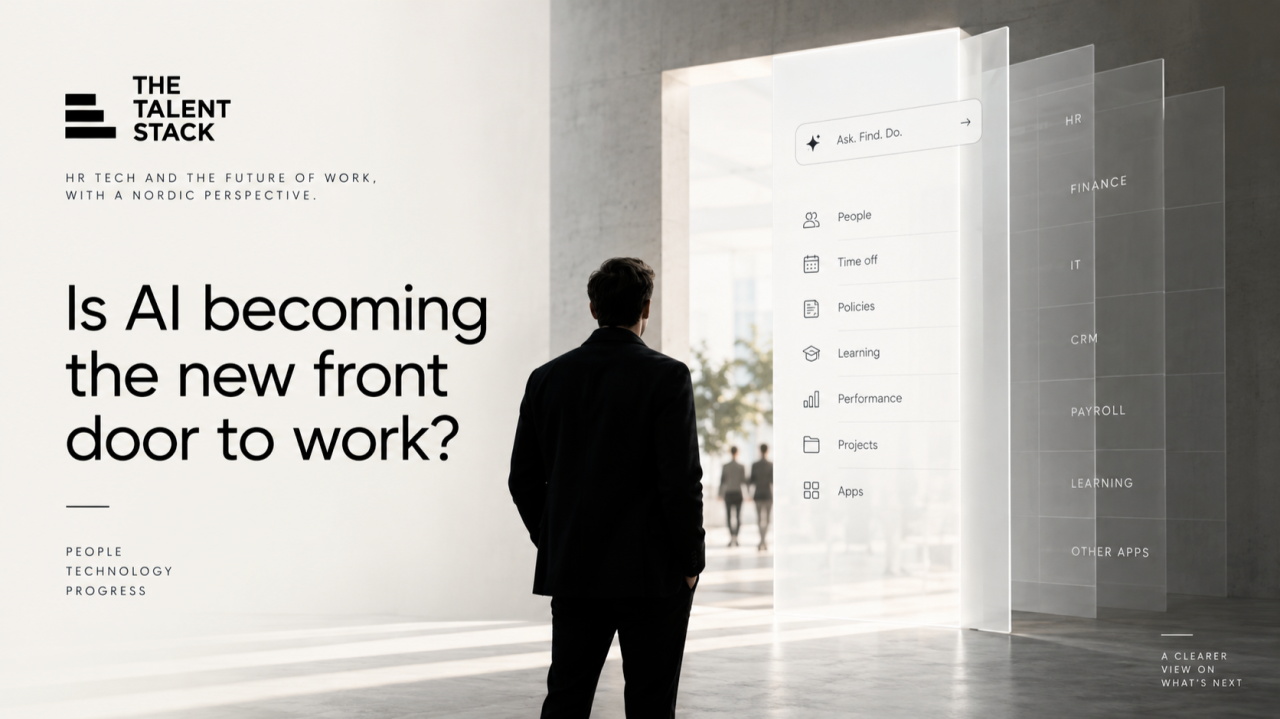
The next generation of workplace AI is challenging that model. Instead of expecting employees to understand the technology stack behind their organisation, the ambition is increasingly to put an intelligent layer in front of it.
You ask. The system finds. And, increasingly, it acts.
From finding information to getting things done
Enterprise search isn’t new. Neither are chatbots or digital assistants.
What’s different now is the combination of conversational AI, enterprise context and agents capable of taking action.
The distinction matters.
An employee asking, “How many vacation days do I have left?” shouldn’t necessarily need to know which HR system contains that information. More importantly, if the next question is “Can I take next Friday off?”, the experience shouldn’t end with an answer and a link to another application.
The emerging idea is that the same interface could understand the request, access the relevant information, respect the employee’s permissions and initiate the appropriate workflow.
We’re beginning to see this direction across enterprise technology.
Microsoft and SAP, for example, now integrate Copilot and Joule so users can access certain SAP capabilities from Microsoft Copilot and Teams. An employee can ask about their remaining leave balance in Copilot, with the request routed to SAP SuccessFactors behind the scenes.
Workday is approaching the same problem from another direction.
Its acquisition of Swedish AI company Sana brought enterprise search, agents and learning into its platform. Workday describes its ambition as becoming the “front door for work”: an interface connecting information and actions across Workday and other enterprise applications. The company completed the $1.1 billion acquisition in November 2025 and began rolling out Sana based capabilities more broadly in March this year.
The individual products matter. But the direction of travel matters more.
The interface is becoming a battleground
For years, enterprise software competition largely centred on owning systems of record.
Who owns the employee record? The financial data? Recruiting? Payroll? Learning?
AI introduces another potentially valuable position: who owns the interface through which employees access all of those systems?
If an AI assistant can understand what an employee wants and connect to the right system behind the scenes, the underlying application becomes less visible.
That’s a meaningful change.
Employees may eventually care less about where information or processes live. They simply expect the organisation’s technology to understand what they’re trying to accomplish.
And that could gradually change what a good employee experience means.
But there may never be one front door
The phrase “front door to work” is appealing because it makes an enormously complicated technology problem sound simple.
Reality is messier.
A salesperson may spend most of the day in CRM and email. A store manager might rarely sit at a computer. A recruiter lives in completely different systems from a finance analyst. And many organisations operate a mixture of platforms accumulated over years.
So the future may not be one universal application where everyone starts their day.
A more plausible outcome is that the interface becomes portable.
The intelligent layer follows the employee into the tools they already use, while connecting systems and information underneath. The integration between SAP’s Joule and Microsoft Copilot is an early example of this approach: the user can remain inside Microsoft while accessing information held within SAP.
That distinction could prove important.
The winner of the next phase of enterprise technology may not be the company that persuades employees to open another application.
It may be the one that makes employees think about applications less.
What this means for HR leaders
For HR, the interesting question isn’t whether one AI assistant ultimately becomes the front door to work.
It’s where friction can disappear.
Think about how much HR activity still depends on employees knowing where to go, what something is called, which process applies or whom to ask.
AI potentially removes some of that burden.
But it also introduces harder questions. What information should an agent be allowed to access? Which actions can it take autonomously? What happens when information conflicts across systems? Who is accountable when an automated action is wrong?
For Nordic organisations in particular, where employee trust, transparency and increasingly European AI regulation form part of the operating environment, those questions deserve as much attention as the technology itself.
A quieter shift in enterprise software
It’s tempting to view the current wave of enterprise AI as another collection of features being added to familiar platforms.
That may underestimate what’s happening.
The more interesting shift is not that software can answer better questions. It’s that the relationship between employees and enterprise systems may be changing.
For decades, people have adapted to software.
The next generation of enterprise technology is betting that software can finally start adapting to people.
And if that happens, the most important interface in the workplace might eventually be the one that makes the rest of the technology stack almost invisible.
Sources & further reading
This article draws on publicly available announcements and product documentation from Workday, Microsoft and SAP.